Abrasive Cutting: Weighing the Benefits Against the Drawbacks

If you've ever worked with metal, you know that cutting it isn't always as simple as taking a saw to a piece of wood. When you get into materials like hardened steel, superalloys used in jets, or even dense ceramics, a standard saw blade just won't... well, cut it.
So, how do you slice through a 4-inch-thick bar of solid, hardened steel? One of the most common and powerful methods is abrasive cutting.
But what exactly is it?
Let’s ditch the technical jargon for a second. Imagine trying to cut a plank of wood with a piece of sandpaper. If you just rub it, you'll slowly sand it down. But what if you wrapped that sandpaper around a disc and spun it at 3,000 RPM? You'd grind a path right through the wood.
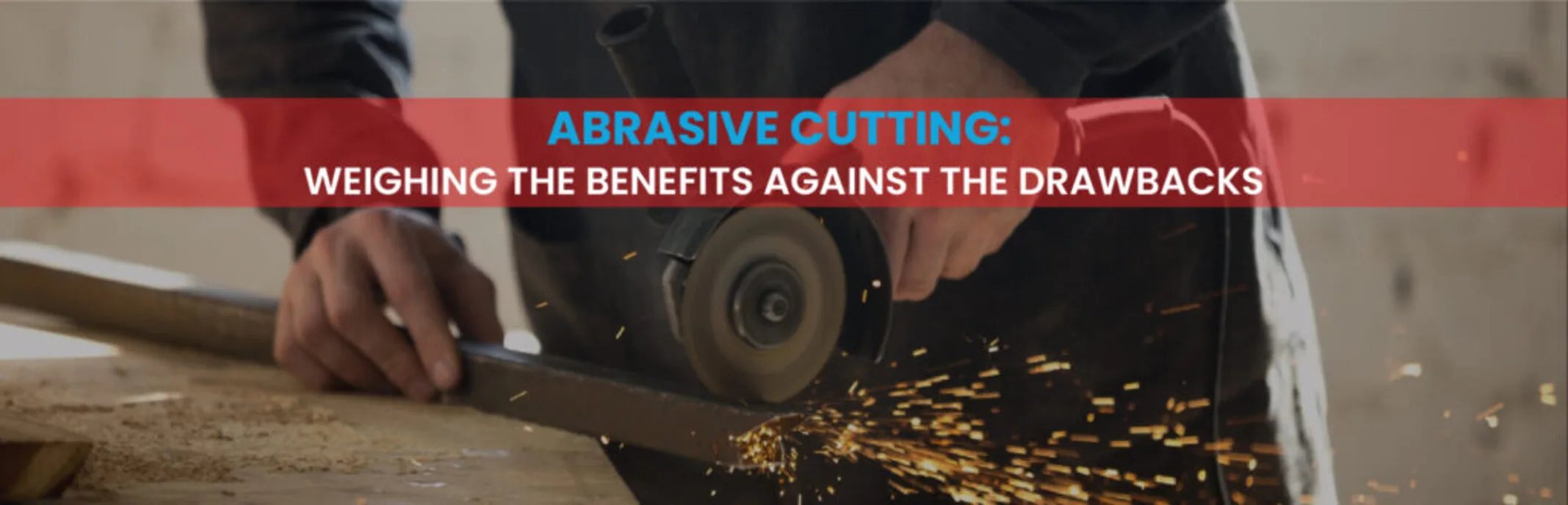
That, in a nutshell, is abrasive cutting. Instead of sharp, "toothed" blades that shear off material, this method uses a high-speed, spinning disc called an abrasive cutting wheel loaded with millions of tiny, super-hard mineral particles. These particles act like microscopic cutting tools, grinding away the material to create a clean-looking, if not perfectly smooth, cut. This makes it the premier method for cutting abrasive materials that would destroy standard high-speed steel tools.
It’s a powerhouse in the metal cutting world, used in foundries, machine shops, and metallurgical labs every day. But it's not a one-size-fits-all solution. Like any powerful tool, it has a distinct set of pros and cons.
As a leading supplier of industrial tools, we at M-Source believe in helping you find the right tool for the job. So, let’s look honestly at where abrasive cutting shines and where it falls short.
The "Good Stuff" – Why Choose Abrasive Cutting?
There are some excellent reasons why this method has been a workshop staple for decades. The benefits are all about power, versatility, and cost.
1. It Cuts (Almost) Anything
This is the true superpower of abrasive cutting. Because the process is grinding rather than shearing, the hardness of the material you're cutting is almost irrelevant.
A traditional saw blade must be more complicated than the material it's cutting so its teeth can "bite" and form a chip. When you reach materials like hardened D2 tool steel, Inconel (a superalloy), or titanium, a toothed blade will dull or shatter in seconds.
An abrasive cutting wheel doesn't care. Its powerful 3m abrasives (like aluminum oxide or silicon carbide) are among the hardest materials on earth. It will grind its way through:
- Extremely Hard Metals: Hardened steels, tool steels, and exotic nickel-based alloys.
- Rigid Composites: Materials like carbon fiber.
- Brittle Materials: It's also surprisingly good at cutting things like glass, ceramics, and carbides that would just shatter under the impact of a toothed blade.
2. It's Fast (For the Right Job)
When your goal is to simply separate a piece of material into two, this method is incredibly fast. It’s a beast for "sectioning."
Imagine you work at a steel mill and must test the internal quality of a 6-inch-diameter railroad axle. You need to get a sample slice from the middle. You could spend ages with another method, but a large material abrasive cutter will power through that axle in minutes. This high-speed "bulk removal" is where it truly excels.
3. Lower Upfront Cost and Simplicity
Let's talk money. Compared to other high-tech cutting methods, Abrasive cutting equipment is often far more affordable.
- Laser Cutters: Incredibly precise, but come with a very high price tag, complex optics, and high power demands.
- Waterjet Cutters: Also very precise and cut with no heat (a huge plus!), but they involve ultra-high-pressure pumps (50,000+ PSI) that require specialized, expensive maintenance.
By comparison, an abrasive chop saw is a relatively simple machine: it has a powerful motor, a spindle, and a sturdy frame. This simplicity often translates to easier maintenance and lower repair costs.
The "Heads-Up" – What Are the Drawbacks?
All that power and speed come at a price. You need to be critical and decide if the trade-offs are worth it for your specific application.
1. Heat. Lots of It.
This is, without a doubt, the single biggest drawback. All that high-speed friction between the wheel and the metal generates incredible heat at the cut line.
This creates what engineers call a "Heat Affected Zone" (HAZ). Think of it as a minor, invisible "burn" on the cut edge. This heat can actually change the properties of the metal. It can:
- Harden the edge (making it brittle).
- Soften the edge (annealing it, which reduces its strength).
- Cause "thermal stress," which can lead to microscopic cracks.
If the part you're cutting needs to be precise and strong right to the edge (like a gear), this metallurgical damage is a serious problem. To fight this, most Abrasive cutting equipment floods the cut with liquid coolant, but managing heat is a constant battle.
2. It Can Be a Messy Job
Remember, you're grinding, not cutting. This means you aren't creating nice, clean, spring-like metal chips. You're creating "swarf," a fine, abrasive slurry or dust that mixes tiny metal particles and particles from the wheel itself.
This swarf gets everywhere. If dry, it can be a respiratory hazard, and when mixed with coolant, it creates a messy sludge that has to be filtered and disposed of. This abrasive sludge can also be tough on the machine, accelerating wear on moving parts if not appropriately managed.
3. The Wheel Wears Out (On Purpose)
An abrasive cutting wheel is a consumable item. It's designed to wear down.
This is a clever feature: as the abrasive grains on the wheel get dull from cutting, the "bond" (the glue holding them) is designed to break down, releasing the dull grains and exposing fresh, sharp grains underneath. This is called "friability," which keeps the wheel cutting effectively.
But it means two things:
- Cost: You are constantly buying new wheels. This consumable cost must be factored into your budget, whereas a band saw blade can often be resharpened multiple times.
- Process: As the wheel gets smaller in diameter, its surface speed changes, affecting the cut quality and time.
4. It's Not a Precision Tool
If you need to cut an intricate shape, a tiny slot, or a part with a mirror-smooth finish, abrasive cutting is the wrong tool.
- Cut Finish: The surface it leaves behind is a "ground" finish, which is relatively rough. It often requires a secondary machining step (like milling or grinding) to make it smooth and precise.
- Burrs: It almost always leaves a "burr" (a small, sharp ridge of metal) on the edge of the cut that has to be removed.
- Kerf: The cut (the "kerf") is quite wide, much wider than a laser or waterjet. You'll lose more material to the cut itself.
Conclusion
So, when should you choose abrasive cutting?
It's the right choice when your priorities are:
- Cutting extremely hard or brittle materials that other methods can't handle.
- Speed and power for "sectioning" or bulk-cutting large stock.
- Low upfront machine cost is a significant factor.
It's the wrong choice when your priorities are:
- Avoiding heat at all costs (e.g., cutting sensitive electronics or medical-grade parts).
- High precision and a perfectly smooth "as-cut" finish.
- Cutting intricate, complex shapes and patterns.
Abrasive cutting is a vital, powerful workhorse in the metal cutting industry. It’s the tool you grab when you need to bring raw power to bear on a rigid material. The secret is knowing its limitations. You're trading precision, a cool cut for raw speed, and the versatility to cut nearly anything.
Understanding this trade-off is the first step. The next is selecting the right Abrasive products, including the perfect wheel type, abrasive grain, and bond for your specific material. This can make all the difference in managing heat and getting a clean cut.